October 20, 2026
Higher Bond Yields cause allocators to re-evaluate

KEY SUMMARY POINTS
- Higher bond yields have improved the attractiveness of government bonds. As yields reached more compelling levels, portfolios increased exposure to government bonds and eliminated their previous underweight position.
- Portfolio positioning has moved closer to neutral. Equity exposure was reduced modestly, reflecting a more balanced asset allocation approach amid evolving market conditions.
- As part of the portfolio strategy, adjustments were implemented while maintaining a neutral duration stance. This positioning has been consistently applied across CI Global Income & Growth, CI Canadian Income & Growth, and CI Canadian Asset Allocation.
WHAT CHANGED IN THE PORTFOLIOS?
- Increased government bond exposure as yields reached more attractive levels.
- Reduced equity exposure modestly and moved portfolios closer to neutral.
- Eliminated the underweight position in government bonds.
- Maintained a neutral duration stance.
- The changes are reflected across the following strategies: CI Global Income & Growth, CI Canadian Income & Growth, and CI Canadian Asset Allocation.
When Good News Isn't Enough
We share some recent thoughts from our Asset Allocation Committee meeting…
September served as another reminder that markets rarely move in straight lines. While major equity indices finished the month largely unchanged, market leadership became increasingly fragmented. As one member of the Committee observed, "One day the market is rewarding companies tied to AI infrastructure, the next it is focused on semiconductor developers, and shortly after attention shifts to an entirely different segment of the technology ecosystem." Rather than being driven by a single dominant theme, markets appear increasingly dependent on shorter-lived rallies within individual sectors and industries.
Against this backdrop, the Asset Allocation Committee spent less time discussing strong year-to-date market performance and more time debating a much more important question:
What Happens When Expectations Become the Risk?
After a multi-year bull market fueled by resilient economic growth, strong corporate earnings and significant enthusiasm surrounding artificial intelligence, investors remain eager to buy every market dip.
Yet beneath the surface, several signals suggest the balance of risks may be beginning to change.
As one committee member observed:
"The market is clearly looking for reasons to rally, but It is becoming increasingly difficult to push it higher."
The discussion ultimately centered on three key themes:
- The growing appeal of government bonds
- Elevated expectations in equity markets
- The possibility that bonds and equities are telling very different stories and how this impacts growth
Are Government Bonds yielding an Advantage?
Government bonds became one of the most heavily debated topics at the meeting. For much of the last several years, maintaining an underweight position in government bonds has been beneficial for portfolio performance. However, the investment landscape is changing. The U.S. 10-year Treasury yield has approached 5%, while longer-dated government bonds have reached levels not seen in decades. Similar moves have occurred across most developed markets. In Canada, the 10-year Government of Canada bond has risen from 3.47% at the beginning of the year to approximately 4.00% today. Source: Bank of Canada. This has led to a question we have increasingly received from advisors: Is it finally time to lean back into government bonds?
The Committee's conclusion was not that interest rates are poised to decline sharply. Rather, higher yields are beginning to offer investors reasonable compensation for uncertainty. As one member put it:
"Do I prefer bonds over cash today? Yes. Do I have a strong conviction that rates are going dramatically lower from here? No.“
The Committee acknowledged that inflation risks remain present and that higher commodity prices could continue to place upward pressure on yields. However, current starting yields have improved the potential return profile for government bonds considerably compared to earlier in the year. As a result, the Committee elected to eliminate its underweight position in government bonds and move portfolios closer to neutral positioning. This adjustment was funded equally through reductions in cash and equities, while maintaining a neutral duration stance.
The Problem Isn't Earnings. It's Expectations.
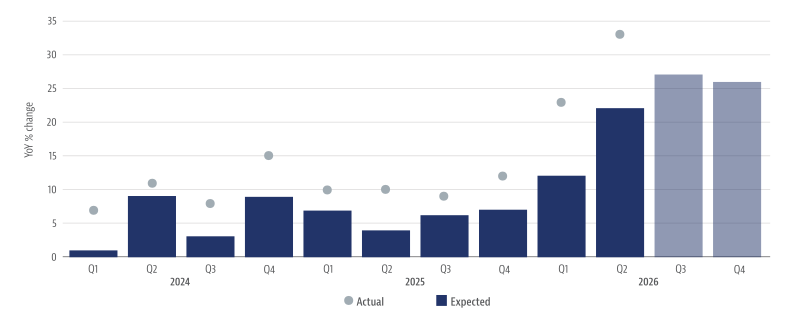
The Committee remains constructive on long-term earnings growth, particularly among businesses benefiting from ongoing AI-related investment spending. However, a recurring theme throughout the discussion was that the greatest challenge facing equities today may not be deteriorating fundamentals. It may be expectations. Many of the market's leading companies continue to report exceptional earnings growth. However, growth rates of 60-70% cannot continue indefinitely. Eventually, even outstanding businesses face the law of large numbers. The important question for investors is not whether growth remains strong. The question is: How will markets react when growth remains good, but simply becomes less extraordinary?
In many areas of the market, valuation multiples already reflect a highly optimistic outlook. As a result, companies may increasingly find themselves in a position where strong earnings are rewarded less generously than they have been over the past several years.
The Committee did not advocate for a wholesale reduction in risk assets, nor did it become negative on equities. However, there was broad agreement that the risk-reward profile has become somewhat less attractive following recent market gains. To reflect this assessment, the Committee modestly reduced equity exposure, bringing portfolios closer to neutral positioning.
Two Markets, Two Stories
Perhaps the most interesting discussion centered on the growing disconnect between signals from the bond market and the equity market. On one hand, bond investors continue to demand significantly higher yields. On the other hand, equity markets remain remarkably resilient, supported by strong earnings growth and continued confidence in the economic outlook. One Committee member summarized the situation succinctly: "You have 10-year yields around 5%, and the equity market acts as if nothing is wrong.“
Another member offered the opposing perspective: "If you're growing revenues at 50% year-over-year, does it really matter whether you're paying 4%, 5% or 6% for your debt?“
Both arguments have merit. Ultimately, the Committee's view is that continued AI-driven investment spending and economic growth should remain supportive of risk assets. However, if either economic momentum or earnings growth begins to moderate, government bonds appear considerably better positioned to provide portfolio diversification than they have in recent years. This distinction is important because stock-bond correlations are highly dependent on the dominant market fear.
When inflation is the primary concern, stocks and bonds often fall together. When growth becomes the primary concern, bonds typically resume their traditional role as a portfolio ballast. With yields now substantially higher, the Committee believes bonds once again have the potential to provide meaningful diversification should growth expectations begin to soften.
S&P 500 Earnings Growth Relative to Consensus Expectations
Portfolio Positioning Changes
Following discussion, the Committee made several modest adjustments:
- Reduced equity exposure, moving closer to neutral positioning.
- Eliminated the underweight position in government bonds.
- Increased government bond exposure using proceeds from both equities and cash.
- Maintained a neutral duration position.
Balance Over Bravado
The Asset Allocation Committee did not leave September's meeting with a dramatically different outlook. Rather, the discussion reflected a subtle but important shift in emphasis. Earlier this year, the key question was whether investors were positioned aggressively enough to participate in the market rally. Today, the question is different: Are investors being adequately compensated for the risks they are taking?
With government bond yields materially higher, equity valuations increasingly demanding and earnings expectations approaching elevated levels, the Committee believes a greater degree of balance is warranted. The result is not a defensive portfolio. It is a more balanced one. While the outlook for growth remains constructive, the Committee believes investors no longer need to rely exclusively on equities for return opportunities. Government bonds have once again become a meaningful source of income, diversification and potential downside protection, leading the Committee to modestly rebalance portfolios toward a more neutral asset allocation stance.
To open this article in a shareable format, click here.
About the Author

Curtis Dwyer is Vice President, Investment Strategy at CI Global Asset Management, where he is responsible for helping advisors and investors navigate markets through portfolio construction insights, macroeconomic analysis, and investment strategy guidance. He works closely with CI GAM’s portfolio management teams to communicate market views, investment positioning, and portfolio solutions across a range of equity, fixed income, and multi-asset strategies. With experience spanning institutional and wealth management environments, Curtis brings a practical perspective to market and investment discussions, helping advisors translate complex economic and market developments into actionable portfolio decisions. His areas of focus include asset allocation, portfolio construction, behavioral finance, retirement income strategies, and the role of diversification in long-term investment success
IMPORTANT DISCLAIMERS:
Commissions, trailing commissions, management fees and expenses all may be associated with mutual fund investments. Please read the prospectus before investing. Mutual funds are not guaranteed, their values change frequently, and past performance may not be repeated.
This document is provided as a general source of information and should not be considered personal, legal, accounting, tax or investment advice, or construed as an endorsement or recommendation of any entity or security discussed. Every effort has been made to ensure that the material contained in this document is accurate at the time of publication. Market conditions may change which may impact the information contained in this document. All charts and illustrations in this document are for illustrative purposes only. They are not intended to predict or project investment results. Individuals should seek the advice of professionals, as appropriate, regarding any particular investment. Investors should consult their professional advisors prior to implementing any changes to their investment strategies.
The opinions expressed in the communication are solely those of the author(s) and are not to be used or construed as investment advice or as an endorsement or recommendation of any entity or security discussed.
Certain names, words, titles, phrases, logos, icons, graphics, or designs in this document may constitute trade names, registered or unregistered trademarks or service marks of CI Investments Inc., its subsidiaries, or affiliates, used with permission. All other marks are the property of their respective owners and are used with permission.
Certain statements contained in this communication are based in whole or in part on information provided by third parties and CI Global Asset Management has taken reasonable steps to ensure their accuracy. Market conditions may change which may impact the information contained in this document.
Certain statements in this document are forward-looking. Forward-looking statements (“FLS”) are statements that are predictive in nature, depend upon or refer to future events or conditions, or that include words such as “may,” “will,” “should,” “could,” “expect,” “anticipate,” “intend,” “plan,” “believe” or “estimate” or other similar expressions. Statements that look forward in time or include anything other than historical information are subject to risks and uncertainties, and actual results, actions or events could differ materially from those set forth in the FLS. FLS are not guarantees of future performance and are by their nature based on numerous assumptions. Although the FLS contained herein are based upon what CI Global Asset Management and the portfolio manager believe to be reasonable assumptions, neither CI Global Asset Management nor the portfolio manager can assure that actual results will be consistent with these FLS. The reader is cautioned to consider the FLS carefully and not to place undue reliance on FLS. Unless required by applicable law, it is not undertaken, and specifically disclaimed that there is any intention or obligation to update or revise FLS, whether as a result of new information, future events or otherwise.
CI Global Asset Management is a registered business name of CI Investments Inc.
© CI Investments Inc. 2026. All rights reserved.
