August 07, 2026
Japanese Yen (JPY): More Than Intervention?

KEY SUMMARY POINTS
- Coordinated U.S.-Japan intervention suggests a potential shift in the policy stance toward yen weakness.
- Narrowing interest rate differentials remain the key condition for a sustained yen recovery.
- Deep undervaluation and potential capital repatriation could provide additional support for the yen.
A Changing Policy Reaction Function
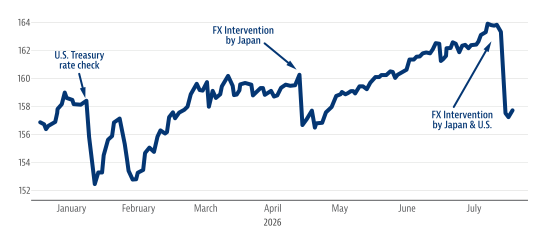
The Japanese yen has strengthened following coordinated action by Japanese authorities and the U.S. Treasury. That matters. Japan’s Ministry of Finance has been trying to stabilize yen depreciation for several years, with mixed and often temporary results. What is different this time is not simply that Japan is pushing back again. It is that the U.S. appears willing to be involved.
This should not be dismissed as another short-lived bout of intervention. Currency intervention rarely changes a trend by itself, but it can change market behaviour when it tells investors that the policy reaction function has shifted.
Exhibit 1: USD/JPY and the changing policy reaction function
USDJPY
 USDJPY
Source: Bloomberg Finance LP, Macrobond As of August 4, 2026
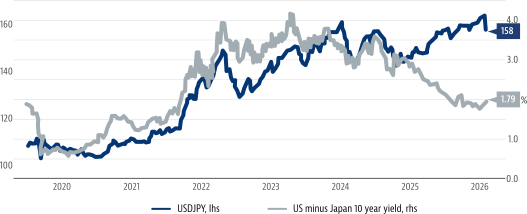
Exhibit 2: Further narrowing in rate differentials could support JPY
USDJPY vs. 10 year yield differential
 USDJPY vs 10y yield
Source: Macrobond Financial AB, Bloomberg, Macrobond As of August 4, 2026
The signal here is that yen weakness may no longer be viewed only as a Japanese problem. It may also be viewed in Washington as part of a broader set of currency and trade imbalances that have left the U.S. dollar persistently strong and some trading partners with an advantage from weaker exchange rates.
Fundamentals Are Becoming More Supportive
For much of the past decade, the yen has been the funding currency of choice. Extremely low Japanese interest rates, combined with higher yields elsewhere, encouraged investors to remain structurally underweight yen and overweight foreign assets. That trade has been powerful because it has had both a yield argument and a momentum argument. Investors were paid to be short yen, and for long stretches they were rewarded by the exchange rate as well.
That is why interest-rate differentials remain the key determinant of staying power. If Japanese rates remain far below those in the U.S. and other major markets, intervention can slow yen weakness but is unlikely to reverse it on a sustained basis. If those differentials continue to narrow, however, the yen could have more room to recover than markets currently assume.
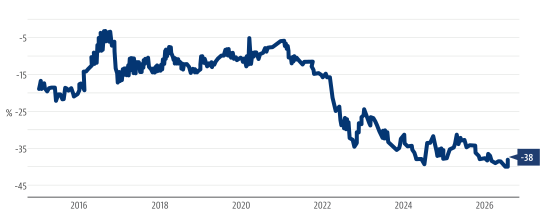
There is also a valuation argument. On an inflation-adjusted purchasing power-parity basis, the yen remains deeply undervalued against the U.S. dollar.
Valuation is not a timing tool, and currencies can remain cheap for years when policy and yield differentials justify it. But the degree of undervaluation matters when the policy backdrop starts to change.
Canada is in a similar position, although less extreme, with the Canadian dollar also screening undervalued in our long-term capital market assumptions. The common thread is that persistent U.S. dollar strength has left several major currencies trading below long-term fair value estimates.
Exhibit 3: The JPY is deeply undervalued
JPY Undervaluation Relative to USD
(CIGAM Long-Term Forecast*)
 JPY undervaluation relative to USD
Source: Bloomberg Finance LP, Macrobond As of August 5, 2026 *2026 forecast used for entire time period
What Else Has Changed?
The shift in Japan is also domestic. Japanese government bond yields have risen from exceptionally low levels, and that changes the arithmetic for large Japanese institutional investors. For years, pension funds, insurers and other long-term allocators had strong incentives to invest abroad in search of yield. As domestic yields become more attractive relative to long-term liabilities, the case for allocating more capital back to Japan becomes more credible. Government efforts appear increasingly aligned with that objective: encourage domestic investors to bring more balance back to their portfolios and reduce the one-way pressure created by foreign asset accumulation.
This is where the yen story could get more interesting. If intervention, higher domestic yields and portfolio repatriation begin to reinforce one another, the market may no longer treat yen strength as a short-term squeeze. It could instead become the early stage of a broader reversal in one of the most crowded structural positions in global currency markets.
The broader implication is that this may not be only about Japan. It may be an early warning shot from U.S. officials that they are less willing to accept a global currency regime in which the U.S. carries the burden of a persistently strong dollar while other countries benefit from weaker currencies.
It is premature to call this a formal weak-dollar policy. But it is not premature to say the market should pay attention when the U.S. Treasury is willing to coordinate around yen strength after a long period of tolerance toward dollar strength.
That point matters for other currencies as well. A stronger euro or Canadian dollar would not necessarily face the same resistance from local policymakers that markets might assume. Stronger currencies can help reduce imported inflation and ease pressure on consumers.
The trade-off is that they can weigh on exporters, but the political economy has changed. After several years of inflation pressure, a firmer currency may be more acceptable than it would have been in a pre-inflation world.
The individuals involved also matter. Scott Bessent and Kevin Warsh both understand markets, the role of incentives and the way policy signals can move positioning without requiring unlimited balance-sheet commitment.
A coordinated, long-term framework between them could give this more durability than a one-off intervention headline. That does not make the outcome certain, but it raises the odds that investors should treat the recent move as strategically important rather than merely tactical.
Investment Implications
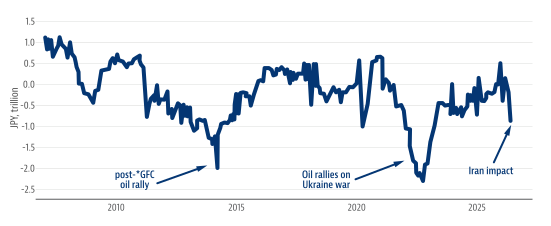
For investors, the practical takeaway is not to assume a straight-line yen rally. The yen still needs help from fundamentals, especially narrower rate differentials and evidence that Japanese capital is beginning to rotate home. Energy prices also remain relevant, given Japan’s dependence on imported energy and the effect of oil prices on the trade balance. But the balance of risks has changed. The market is being asked to reconsider whether yen weakness remains a policy-tolerated trend or has become a policy-sensitive imbalance.
Exhibit 4: Lower energy prices would support JPY
Japan's Goods Trade Balance
 Japan goods trade balance
Source: Japanese Ministry of Finance (MOF), Macrobond As of July 21, 2026 *GFC: Global Financial Crisis
A stronger yen should also not be viewed automatically as negative for Japanese equities. Exporters may face a headwind if currency strength is abrupt, but a more stable currency can improve domestic purchasing power, reduce imported-cost pressure and support confidence in Japan’s economic normalization.
The more important question is whether yen strength is accompanied by higher domestic yields, better capital allocation and continued corporate governance reform. If so, the investment case for Japan can remain intact even with a firmer currency.
Bottom Line
The bottom line is that this may be more than intervention, even if it does not amount to a U.S. weak-dollar policy. Japan has been trying to stabilize the yen for years. The change is U.S. Treasury involvement, which puts yen weakness into a broader debate about currency values, trade advantages and the burden of a persistently strong dollar. Bessent’s point that dollar strength is not simply the level shown on a Bloomberg screen is important.
The dollar’s reserve-currency role rests on stability, policy credibility and deep liquidity, not its value on any single day. That distinction matters. It is too early to call this a secular weak-dollar shift, but policy coordination, extreme yen undervaluation, narrower rate differentials and the potential for Japanese capital to rotate home make this a signal worth taking seriously.
To open this article in a shareable format, click here.
GLOSSARY:
Bond yield: The interest earned on a fixed-income security.
Liquidity: The degree to which an asset or security can be quickly bought or sold in the market without affecting the asset’s price. Cash is considered to be the most liquid asset, while things like fine art or rare books would be relatively illiquid.
About the Author

Lorne Gavsie is Senior Vice-President and Head of Macroeconomic & FX Strategy at CI Global Asset Management.
As Senior Vice-President and Head of Macroeconomic & FX Strategy, Lorne Gavsie leads CI Global Asset Management's global macro platform and serves as portfolio manager for the firm's currency strategies. He contributes to the asset allocation process and oversees the firm’s long-term asset class return framework, which informs investment strategy and portfolio construction.
Lorne has more than 25 years of experience in global financial markets, including senior leadership roles in Toronto and London. He holds a joint MBA from the London School of Economics and Political Science, HEC Paris and NYU Stern School of Business, and is a member of the Bank of Canada's Canadian Foreign Exchange Committee. He also serves on the Executive Board of the International Dyslexia Association, Ontario Branch.
About the Author

Neil Shankar is CI Global Asset Management’s Economist, responsible for monitoring key macroeconomic trends and shaping CI GAM’s economic outlook. He actively participates in investment and asset allocation discussions, helping guide decision-making.
A leading contributor to CI GAM’s Capital Insights publication, Neil shares in-depth perspectives on evolving economic conditions. He also frequently engages with stakeholders throughout the organization and externally, helping to deepen understanding of the economic landscape. He is regularly quoted in the press for his views on the economy and markets.
With over 10 years of industry experience, Neil joined CI GAM in 2024 after holding similar roles at other major Canadian financial institutions. Neil holds an MA in Business Economics from Wilfrid Laurier University and a BA (Honours) in Economics from The University of Western Ontario.
IMPORTANT DISCLAIMERS
Commissions, trailing commissions, management fees and expenses all may be associated with mutual fund investments. Please read the prospectus before investing. Mutual funds are not guaranteed, their values change frequently, and past performance may not be repeated.
This document is provided as a general source of information and should not be considered personal, legal, accounting, tax or investment advice, or construed as an endorsement or recommendation of any entity or security discussed. Every effort has been made to ensure that the material contained in this document is accurate at the time of publication. Market conditions may change which may impact the information contained in this document. All charts and illustrations in this document are for illustrative purposes only. They are not intended to predict or project investment results. Individuals should seek the advice of professionals, as appropriate, regarding any particular investment. Investors should consult their professional advisors prior to implementing any changes to their investment strategies.
The author and/or a member of their immediate family may hold specific holdings/securities discussed in this document. Any opinion or information provided are solely those of the author and does not constitute investment advice or an endorsement or recommendation of any entity or security discussed or provided by CI Global Asset Management.
Certain names, words, titles, phrases, logos, icons, graphics, or designs in this document may constitute trade names, registered or unregistered trademarks or service marks of CI Investments Inc., its subsidiaries, or affiliates, used with permission. All other marks are the property of their respective owners and are used with permission.
Certain statements contained in this communication are based in whole or in part on information provided by third parties and CI Global Asset Management has taken reasonable steps to ensure their accuracy. Market conditions may change which may impact the information contained in this document.
Certain statements in this document are forward-looking. Forward-looking statements (“FLS”) are statements that are predictive in nature, depend upon or refer to future events or conditions, or that include words such as “may,” “will,” “should,” “could,” “expect,” “anticipate,” “intend,” “plan,” “believe” or “estimate” or other similar expressions. Statements that look forward in time or include anything other than historical information are subject to risks and uncertainties, and actual results, actions or events could differ materially from those set forth in the FLS. FLS are not guarantees of future performance and are by their nature based on numerous assumptions. Although the FLS contained herein are based upon what CI Global Asset Management and the portfolio manager believe to be reasonable assumptions, neither CI Global Asset Management nor the portfolio manager can assure that actual results will be consistent with these FLS. The reader is cautioned to consider the FLS carefully and not to place undue reliance on FLS. Unless required by applicable law, it is not undertaken, and specifically disclaimed that there is any intention or obligation to update or revise FLS, whether as a result of new information, future events or otherwise.
CI Global Asset Management is a registered business name of CI Investments Inc.
© CI Investments Inc. 2026. All rights reserved.
Published August 5, 2026
