August 24, 2026
Long Yields and the Search for Demand

KEY SUMMARY POINTS
- Long-term Treasury yields have risen to multi-year highs as persistent government deficits have increased the amount issuance markets must absorb.
- Strong economic growth, increased investment grade issuance, and sticky inflation are also contributing to higher long-term yields.
- Recent intervention by the U.S. Treasury sends a strong signal to markets that policymakers are willing to respond if long-end yields move higher.
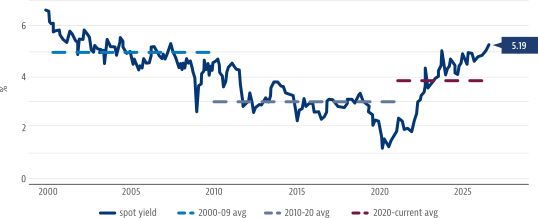
The recent rise in 30-year U.S. Treasury yields to multi-year highs cannot be attributed to a single factor. Rather, it reflects a combination of persistent inflation, large structural government deficits, resilient economic growth, and increasingly challenging supply-demand dynamics, with fewer buyers available to absorb a growing volume of government debt.
More government bonds to go around
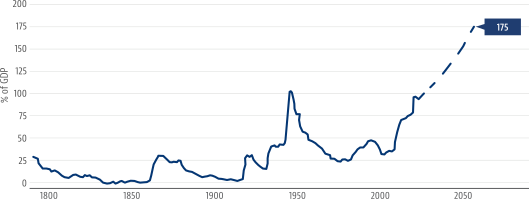
High government spending has become the norm not only in the United States but across many developed economies.
Exhibit 1: The U.S. 30-year yield is at its highest level in nearly two decades
U.S. 30 Year Yield
Source: U.S. Department of Treasury, Macrobond
As of August 19, 2026
Exhibit 2: U.S. federal debt is set to continue to rise
U.S. Federal Debt Held by the Public
Source: U.S. Congressional Budget Office (CBO), Macrobond
As of March 19, 2026
Fiscal deficits remain large, persistent, and increasingly broad-based. While the underlying drivers vary by country, the trend is consistent: greater spending on defense, infrastructure, energy security, and industrial policy, largely financed through borrowing. For bond investors, the policy rationale behind these expenditures is less important than their market impact. The key issue is the steadily increasing supply of government bonds that must be absorbed by investors.
Fewer buyers of government bonds
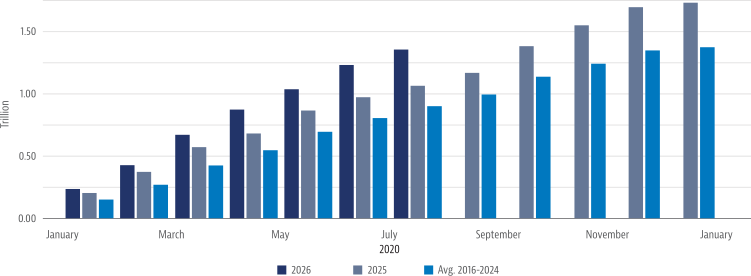
At the same time, demand for long-term government debt has weakened. Central banks are no longer expanding their balance sheets by purchasing duration, and foreign official demand appears less robust than in previous years. More recently, the hedge fund basis trade, which involves buying government bonds, has lost momentum and is providing less support to the market. Corporate issuance, particularly by hyperscalers, represents another important headwind. At the margin, new capital that flows into long-dated IG corporate bonds is money that is not going into government bonds.
Exhibit 3: IG issuance has continued to increase
U.S. Investment Grade Annual Corporate Debt Issuance (Cumulative)
Source: SIFMA (Securities Industry & Financial Markets Association), Macrobond
As of August 5, 2026
Good growth and rising productivity may require higher rates
There are also fundamental reasons why yields may need to remain elevated. If economic growth continues to hold up, the AI-driven capital expenditure boom persists, and fiscal policy remains supportive, investors may conclude that current interest rates are not significantly restraining economic activity. In that environment, yields could remain near current levels for an extended period.
Sticky inflation quickly erodes the value of money
Inflation in the United States has remained above target for nearly five years. Fed Chairman Warsh has repeatedly highlighted this challenge, yet when questioned about the path of short-term interest rates, he has been vague and hesitant about the need for rate hikes. If monetary policy is not sufficiently restrictive, inflation is likely to remain above target, reducing the real value of future cash flows and making long-term debt less attractive to investors.
Sum of the parts = higher risk premium
Faced with a growing supply of long-dated government debt, persistent inflation, and reduced demand, investors require greater compensation to hold long-term bonds. Markets will ultimately clear, but only at higher yields that reflect this elevated risk premium.
Bottom Line
While there are solid fundamental reasons for yields to remain higher than they were over the past decade, the sharp increase in risk premiums has drawn the attention of policymakers. While neither the Treasury nor the Fed can eliminate government deficits or slow AI-related investment spending, they can influence the maturity profile of government debt and the amount of duration the market must absorb. In fact, the U.S. Treasury announced a doubling of long-term bond buybacks, an action expected to reduce the supply of 20- and 30-year bonds by approximately 14% to 16%.
Such interventions are far from unprecedented, but their historical record is mixed. Examples globally include Japan and the United Kingdom, which have suffered episodes of disorderly rise in long-term yields. In both cases, after a period of calm following intervention or policy adjustments, yields resumed their path higher following fundamentals or the global yield backdrop.
Recent intervention sends a strong signal to the market, and we therefore expect it to cap long-end yields and reduce rate volatility in the near term. Over the medium term, however, it remains unclear whether interventions will be sufficient to counter the fundamental forces driving yields and risk premiums higher. Sustained relief for long-term bonds will likely require renewed confidence in the Fed’s inflation-fighting credibility, stronger investor demand, moderating investment-grade corporate issuance, or a meaningful slowdown in economic growth.
To open this article in a shareable format, click here.
About the Author

Lorne Gavsie is Senior Vice-President and Head of Macroeconomic & FX Strategy at CI Global Asset Management.
As Senior Vice-President and Head of Macroeconomic & FX Strategy, Lorne Gavsie leads CI Global Asset Management's global macro platform and serves as portfolio manager for the firm's currency strategies. He contributes to the asset allocation process and oversees the firm’s long-term asset class return framework, which informs investment strategy and portfolio construction.
Lorne has more than 25 years of experience in global financial markets, including senior leadership roles in Toronto and London. He holds a joint MBA from the London School of Economics and Political Science, HEC Paris and NYU Stern School of Business, and is a member of the Bank of Canada's Canadian Foreign Exchange Committee. He also serves on the Executive Board of the International Dyslexia Association, Ontario Branch.
About the Author

Neil Shankar is CI Global Asset Management’s Economist, responsible for monitoring key macroeconomic trends and shaping CI GAM’s economic outlook. He actively participates in investment and asset allocation discussions, helping guide decision-making.
A leading contributor to CI GAM’s Capital Insights publication, Neil shares in-depth perspectives on evolving economic conditions. He also frequently engages with stakeholders throughout the organization and externally, helping to deepen understanding of the economic landscape. He is regularly quoted in the press for his views on the economy and markets.
With over 10 years of industry experience, Neil joined CI GAM in 2024 after holding similar roles at other major Canadian financial institutions. Neil holds an MA in Business Economics from Wilfrid Laurier University and a BA (Honours) in Economics from The University of Western Ontario.
About the Author

Fernanda Fenton, Vice President, Portfolio Manager – Fixed Income, brings over 11 years of investment management experience, with over 15 years in the financial services industry, to her role. At CI GAM, Fernanda is a portfolio manager specializing in global interest rates and emerging markets fixed income. Before CI GAM, Fernanda was an associate portfolio manager at another Canadian asset manager. Prior to that, she spent six years in Latin America debt capital markets and investment banking at Credit Suisse in New York. Fernanda is a CFA charterholder, holds a Master of Business Administration degree from the University of California at Berkeley, and a Bachelor of Arts (Honors) from the Instituto Tecnológico Autónomo de México in Mexico City.
GLOSSARY:
Bond yield: The interest earned on a fixed-income security.
Liquidity: The degree to which an asset or security can be quickly bought or sold in the market without affecting the asset’s price. Cash is considered to be the most liquid asset, while things like fine art or rare books would be relatively illiquid.
IMPORTANT DISCLAIMERS
This document is provided as a general source of information and should not be considered personal, legal, accounting, tax or investment advice, or construed as an endorsement or recommendation of any entity or security discussed. Every effort has been made to ensure that the material contained in this document is accurate at the time of publication. Market conditions may change which may impact the information contained in this document. All charts and illustrations in this document are for illustrative purposes only. They are not intended to predict or project investment results. Individuals should seek the advice of professionals, as appropriate, regarding any particular investment. Investors should consult their professional advisors prior to implementing any changes to their investment strategies.
The author and/or a member of their immediate family may hold specific holdings/securities discussed in this document. Any opinion or information provided are solely those of the author and does not constitute investment advice or an endorsement or recommendation of any entity or security discussed or provided by CI Global Asset Management.
Certain names, words, titles, phrases, logos, icons, graphics, or designs in this document may constitute trade names, registered or unregistered trademarks or service marks of CI Investments Inc., its subsidiaries, or affiliates, used with permission. All other marks are the property of their respective owners and are used with permission.
Certain statements contained in this communication are based in whole or in part on information provided by third parties and CI Global Asset Management has taken reasonable steps to ensure their accuracy. Market conditions may change which may impact the information contained in this document.
Certain statements in this document are forward-looking. Forward-looking statements (“FLS”) are statements that are predictive in nature, depend upon or refer to future events or conditions, or that include words such as “may,” “will,” “should,” “could,” “expect,” “anticipate,” “intend,” “plan,” “believe” or “estimate” or other similar expressions. Statements that look forward in time or include anything other than historical information are subject to risks and uncertainties, and actual results, actions or events could differ materially from those set forth in the FLS. FLS are not guarantees of future performance and are by their nature based on numerous assumptions. Although the FLS contained herein are based upon what CI Global Asset Management and the portfolio manager believe to be reasonable assumptions, neither CI Global Asset Management nor the portfolio manager can assure that actual results will be consistent with these FLS. The reader is cautioned to consider the FLS carefully and not to place undue reliance on FLS. Unless required by applicable law, it is not undertaken, and specifically disclaimed that there is any intention or obligation to update or revise FLS, whether as a result of new information, future events or otherwise.
CI Global Asset Management is a registered business name of CI Investments Inc.
© CI Investments Inc. 2026. All rights reserved.
Published August 24, 2026
