July 10, 2026
The New Era of Hyperscalers Issuance

KEY SUMMARY POINTS
- Artificial intelligence is driving a significant infrastructure investment cycle. Hyperscalers are at the helm driving expected capex spending into the trillions through 2030.
- Google and Amazon tapped the Canadian investment grade market, marking their inaugural deals denominated in Canadian dollar. Mega-cap issuers have diversified from US dollar issuance to expand their access to capital markets and grow a broader investment base.
- CI GAM’s institutional platform enables access to large, often oversubscribed new issues, backed by deep credit due diligence expertise.
Background on AI/Capex Race
Following the release of ChatGPT in Q4 2022, artificial intelligence (AI) rose in prominence and has become an area of competition and investment for Google, Amazon, Oracle, Meta and Microsoft (hyperscalers). These companies are racing to build the infrastructure needed to train, run, and deliver AI models to consumers and businesses. The process requires significant investment in data centres, GPUs, electricity and cooling systems, among other key infrastructure needs. As AI models become more advanced, the amount of computing power required continues to grow. As a result, hyperscalers continue heavily investing in capital expenditures (capex) to remain competitive. AI is becoming a core part of future growth, and companies with the most reliable and efficient infrastructure will be better positioned to retain customers, grow their client base and secure future revenue streams. This has made capital markets an important funding source for companies with strong balance sheets and large cash flow generation that were not frequent issuers in the past.
The Scale of Capex
AI adoption remains in its early innings and demand for data centers continues to grow. Along with rising electricity and chip demand, it has caused capex spending to increase sharply over the last few years1. In 2026, capex is expected to exceed $700 billion, with spending set to rise to $1.1 trillion in 2027. Through 2030, the total AI-related capex is projected to reach $5.5 trillion. A significant portion is expected to be funded through debt and equity markets. The debt financing component of the AI capex buildout is expected to reach $4.1 trillion by 2030, with half coming from investment-grade (IG) debt issuance*. It is not a short-term spending spike; AI infrastructure is becoming a multi-year investment cycle, and the scale of required funding is substantial.
Exhibit 1
Total hyperscaler debt issuance USD
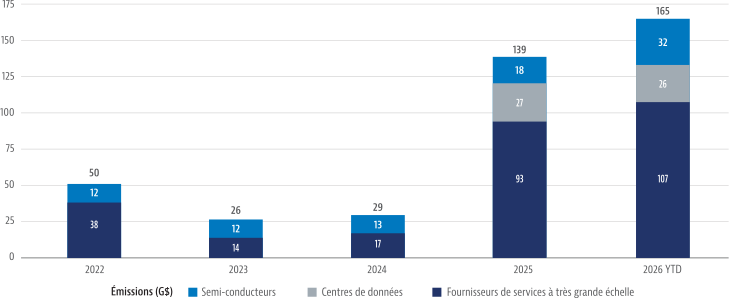 Source: J.P. Morgan, Dealogic. June 16, 2026
Why Capital Markets?
Although hyperscalers have strong balance sheets and significant operating cash flow (OCF), the scale of AI investment is outsized. Companies may be able to cover near-term capex needs with internal cash flow, with OCF expected to exceed $900 billion by 2027.
Relying solely on internal cash flow could reduce financial flexibility. By accessing capital markets early, hyperscalers can leverage projects, while preserving cash for current and future needs. The issuance of debt/equity allows to lock-in pre-funding for needs arising beyond 2027. Raising capital through equity allows hyperscalers to issue large amount of debt without dropping the AA average credit rating. If issuers wait, they risk facing decreased appetite for mega-cap issuance, with higher risk premia (wider spreads) associated with the space2.
Equity implications
On June 1, 2026, Google issued new shares for the first time since its 2004 initial public offering (IPO). The offering was increased to about $84.75 billion by June 3 from an initial $80 billion. Even with this large raise, it only diluted existing shareholders by around 1.5%, showing how valuable its equity is. While this may slightly reduce per‑share metrics in the short term, it doesn’t change the overall investment story. This limited dilution is partly because the raise included different types of securities: common stock, which reduces ownership immediately, and mandatory convertible preferred stock (MCPS), which acts more like future equity. The MCPS pays a 6.25% dividend now and converts into shares in 2029, with capped calls helping to limit additional dilution if the stock price rises significantly. The bigger takeaway is strategic: Google is signaling a shift toward a more capital‑intensive AI model, leaning not just on internal cash flow but also on external equity to fund infrastructure. While this could modestly pressure near‑term earnings per share (EPS), free cash flow (FCF) per share, and the pace of buybacks, the impact is relatively small given Google’s scale. Over the longer term, the investment case will hinge far more on execution. Specifically, whether these AI investments drive durable growth, strengthen Google’s competitive edge, and deliver returns above its cost of capital, the benchmark for value‑creating investment3.
Case study : Amazon’s record CAD issuance
In Q2 2026, Amazon completed its inaugural debt issuance in Canada, a record-breaking $14 billion Canadian dollar (CAD) issuance, following Google’s $8.5 billion CAD issuance earlier in May4. The Canadian market absorbed the issuance well, reflecting strong investor demand. Following the deal, Amazon became the 7th largest issuer in Canada, showcasing how quickly hyperscalers are becoming major participants in global debt markets.
Exhibit 2
Amazon ranks 7th in CAD issuances
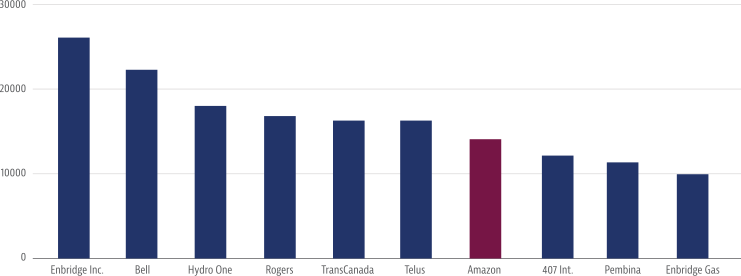 Source: Bloomberg Finance L.P. June 23, 2026
Impact on Canadian Investment Grade market
Following Google’s record setting $8.5 billion CAD debt issuance in May, the Canadian debt market absorbed the incoming supply well5. Amazon’s record-breaking issuance the following month surpassed Google’s deal, created minimal pressure in the market as fund managers rushed to sell high-quality bonds to make room for the new Amazon offerings. Together, the issuance pushed spreads wider in Canada, rising 1 basis point (bp) after Google’s deal and 2 basis points (bps) following Amazon’s debut.
Comparatively, in the U.S., the average spreads on the issues widened by about 6 bps since the end of April. Overall, following record issuance, the Canadian IG deals outperformed the US deals in secondary market trading.
Why Global Markets?
Hyperscalers are seeking to diversify their funding sources and tap global currencies as their financing needs grow. Issuing early in foreign markets establishes a reference curve and develops an investor base that is more likely to participate in future deals. Hyperscalers have issued in Europe and the UK in 2026, with Google famously issuing a rare 100-year sterling bond in the UK, an ultra-long-term that is rare in the corporate space. First mover advantage in foreign markets benefits hyperscalers with funding predictability and a broader market to tap into for future high capex needs.
Institutional access at CI
CI Global Asset Management (CI GAM) brings institutional-grade fixed income expertise to an increasingly complex and fast-evolving market, including areas reshaped by hyperscaler-driven investment cycles. CI GAM’s platform combines deep credit research, active risk management, and global market access with a consistent focus on liquidity, downside protection, and relative value. The portfolio management team complements this with ongoing thought leadership that translates macroeconomic shifts, such as the impact of large-scale AI and infrastructure spending on rates, credit dispersion, and sector opportunities, into actionable portfolio positioning.
CI Funds
CI GAM's fixed income portfolio management team has been actively researching the AI and hyperscaler financing theme, assessing how this new wave of issuance is reshaping corporate credit and where it may fit across client mandates. Amazon and Google investment grade debt have both been held by the investment team.
As opportunities fit their objectives, mandates with exposure to investment grade, such as CI Investment Grade Bond Fund, CI Corporate Bond Fund, and CI Global Unconstrained Bond Fund, may hold AI-adjacent issuers, including the hyperscalers, as part of their exposure to this evolving segment of the market.
To open this article in a shareable format, click here.
Footnotes:
1 Since November, electricity demand has risen from 122 gigawatts (GW) to a staggering 138 GW through 2030, showcasing the growth in demand following AI needs.
* J.P. Morgan, AI Capex 2.0, If you build it, they will finance it – Updated growth & capital markets forecasts, June 16 2026.
2 The credit rating is based off interest coverage ratios, which allows agencies to measure a company’s ability to meet interest payments from operating earnings calculated by dividing earnings before interest and taxes (EBIT) by the interest expense. A sharp raise in interest expense would deteriorate the interest coverage ratio and therefore credit rating agencies could view this change in capital structure as more aggressive (risky). Using a mix of both debt and equity balances capital structure by protecting the interest coverage ratio and preserving access to low-cost funding.
3 The cost of capital is the minimum return a company must earn on investments to satisfy investors (both equity and debt holders), often used as a benchmark to evaluate whether capital allocation creates value.
4 On June 12th, 2026, Amazon issued a $14 billion CAD five-tranche offering. The tranches were as follows: $1.25 billion at 3 years, $2.5 billion at 5 years, $2.0 billion at 7 years, $3.5 billion at 10 years, and $4.75 billion at 30 years.
5On May 15th, 2026, Google issued a $8.5 billion CAD four-tranche offering. The tranches were as follows: $1.5 billion at 5 years, $2.0 billion at 7 years, $2.25 billion at 10 years, and $2.75 billion at 30 years.
GLOSSARY:
Fiscal policy: Measures a government takes to influence the direction of the economy (e.g., tax rate increases or decreases, government spending increases or decreases).
Leverage: An investment strategy of using borrowed money - specifically, the use of various financial instruments or borrowed capital – to increase the potential return of an investment.
Volatility: Measures how much the price of a security, derivative, or index fluctuates. The most commonly used measure of volatility when it comes to investment funds is standard deviation.
DXY: The term DXY refers to the U.S. Dollar Index, which measures the value of the U.S. dollar relative to a basket of six major foreign currencies, including the euro, Japanese yen, British pound, Canadian dollar, Swedish krona, and Swiss franc. It serves as a benchmark for the strength of the U.S. dollar in the global market.
About the Author

The Investment Advisory team is a specialized group within CI Global Asset Management, organized by asset class coverage and focused on providing product expertise and strategic guidance across CI GAM’s advised and sub advised strategies. The team works closely with Portfolio Management, the Distribution team, and institutional partners to refine product positioning and deliver actionable, competitive insights for advisors and investors. With deep expertise in investment strategy, the team supports the continued growth of CI GAM’s investment solutions.
IMPORTANT DISCLAIMERS
Commissions, trailing commissions, management fees and expenses all may be associated with mutual fund investments. Please read the prospectus before investing. Mutual funds are not guaranteed, their values change frequently, and past performance may not be repeated.
This document is provided as a general source of information and should not be considered personal, legal, accounting, tax or investment advice, or construed as an endorsement or recommendation of any entity or security discussed. Every effort has been made to ensure that the material contained in this document is accurate at the time of publication. Market conditions may change which may impact the information contained in this document. All charts and illustrations in this document are for illustrative purposes only. They are not intended to predict or project investment results. Individuals should seek the advice of professionals, as appropriate, regarding any particular investment. Investors should consult their professional advisors prior to implementing any changes to their investment strategies.
The author and/or a member of their immediate family may hold specific holdings/securities discussed in this document. Any opinion or information provided are solely those of the author and does not constitute investment advice or an endorsement or recommendation of any entity or security discussed or provided by CI Global Asset Management.
Certain names, words, titles, phrases, logos, icons, graphics, or designs in this document may constitute trade names, registered or unregistered trademarks or service marks of CI Investments Inc., its subsidiaries, or affiliates, used with permission. All other marks are the property of their respective owners and are used with permission.
Certain statements contained in this communication are based in whole or in part on information provided by third parties and CI Global Asset Management has taken reasonable steps to ensure their accuracy. Market conditions may change which may impact the information contained in this document.
Certain statements in this document are forward-looking. Forward-looking statements (“FLS”) are statements that are predictive in nature, depend upon or refer to future events or conditions, or that include words such as “may,” “will,” “should,” “could,” “expect,” “anticipate,” “intend,” “plan,” “believe” or “estimate” or other similar expressions. Statements that look forward in time or include anything other than historical information are subject to risks and uncertainties, and actual results, actions or events could differ materially from those set forth in the FLS. FLS are not guarantees of future performance and are by their nature based on numerous assumptions. Although the FLS contained herein are based upon what CI Global Asset Management and the portfolio manager believe to be reasonable assumptions, neither CI Global Asset Management nor the portfolio manager can assure that actual results will be consistent with these FLS. The reader is cautioned to consider the FLS carefully and not to place undue reliance on FLS. Unless required by applicable law, it is not undertaken, and specifically disclaimed that there is any intention or obligation to update or revise FLS, whether as a result of new information, future events or otherwise.
CI Global Asset Management is a registered business name of CI Investments Inc.
© CI Investments Inc. 2026. All rights reserved.
Published June 25, 2026
