August 25, 2026
U.S.-Canada Tariffs: Three Scenarios and Their Implications
KEY SUMMARY POINTS
- The direct economic impact of the latest U.S.-Canada tariff escalation appears manageable.
- The bigger risk is not the tariff math itself, but the duration of uncertainty and risk of further escalation.
- A negotiated resolution remains the most likely outcome, but investors should assess the issue through scenarios rather than headlines.
The breakdown in U.S.-Canada trade negotiations, followed by new U.S. tariffs and Canada's retaliatory response, has understandably created a strong political and emotional reaction. Trade disputes between close partners touch issues of sovereignty, fairness, and national interest, not just economics. Markets will react and adjust to the noise created by the twists and turns of the headlines. However, we believe it is important to step back and assess the likely paths from here.
We therefore think the better approach is to frame the issue through scenarios rather than track each turn in the news cycle. The immediate economic hit still looks manageable. Even with the targeted 50% tariffs now in focus, the expected drag on Canadian GDP is less than 0.5%, the net tariff rate rises to about 6%, and 80% of Canadian exports to the U.S. remain tariff free. Any impact would likely be felt most in manufacturing-heavy provinces such as Ontario and Quebec. The bigger risk is what happens if uncertainty lingers: confidence weakens, investment decisions are delayed, and businesses begin planning around a less predictable Canada-U.S. trade relationship.
Scenario 1: Negotiated Resolution Following Initial Escalation
Probability: 50%
This scenario follows the now familiar Trump “TACO” pattern: negotiations break down, rhetoric escalates, tariffs are announced or imposed, markets react, and both sides return to the table within days or weeks. The episode creates volatility, but businesses treat it as a negotiating tactic rather than a lasting change in the trading relationship.
Economic damage would likely be limited. Confidence rebounds as uncertainty fades, delayed spending and hiring decisions resume, and Canadian assets, including the Loonie recover from a shallow pullback. The medium-term outlook remains largely intact, supported by the deep integration of North American supply chains.
Scenario 2: Prolonged Retaliatory Escalation
Probability: 35%
In this scenario, Canada proceeds with retaliatory tariffs and the U.S. responds in kind. Negotiations stall, political pressure rises, and a cycle of retaliation and counter-retaliation lasts for weeks or months before a compromise is eventually reached.
The direct tariff impact remains contained, but uncertainty becomes more damaging. Businesses delay capital spending, hiring plans become more cautious, and foreign investors adopt a more defensive, wait-and-see, stance toward Canadian assets. Some sectors and regions face more pressure, even if the national impact remains manageable.
U.S. Import Duties by Trading Partner
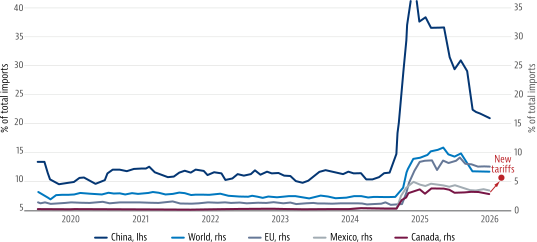
Source: U.S. Census Bureau, Macrobond As of August 4, 2026
Scenario 3: Entrenched Long-Term Tariffs
Probability: 15%
This is the low-probability but highest-consequence scenario. Elevated tariffs remain in place for an extended period and businesses begin to treat uncertainty as permanent rather than temporary.
The greatest risk is the behavioural response. Companies postpone expansion plans, redirect capital, reconsider supply chains, and favour jurisdictions perceived as more predictable. Hiring slows, confidence deteriorates, and investment weakens.
Over time, weaker investment would compound Canada's productivity challenges and weigh on long-term growth. Canadian assets could face a persistent valuation discount, while the Canadian dollar remains under pressure. The damage becomes harder to reverse the longer uncertainty lasts.
U.S. Imports from Canada
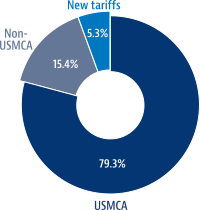
Source: U.S. Census Bureau, Macrobond As of August 23, 2026
Bottom Line
The direct economic impact of the latest tariffs remains manageable, but the duration of uncertainty matters. The headline numbers are not trivial, but they are also not catastrophic: the expected GDP hit is less than 0.5%, the net tariff rate rises to about 6%, and most Canadian exports to the U.S. remain tariff free. If the dispute is resolved quickly, the damage should be limited. If uncertainty persists, confidence, investment, and business behaviour become the main transmission channels to the Canadian economy and markets.
To open this article in a shareable format, click here.
About the Author

Lorne Gavsie is Senior Vice-President and Head of Macroeconomic & FX Strategy at CI Global Asset Management.
As Senior Vice-President and Head of Macroeconomic & FX Strategy, Lorne Gavsie leads CI Global Asset Management's global macro platform and serves as portfolio manager for the firm's currency strategies. He contributes to the asset allocation process and oversees the firm’s long-term asset class return framework, which informs investment strategy and portfolio construction.
Lorne has more than 25 years of experience in global financial markets, including senior leadership roles in Toronto and London. He holds a joint MBA from the London School of Economics and Political Science, HEC Paris and NYU Stern School of Business, and is a member of the Bank of Canada's Canadian Foreign Exchange Committee. He also serves on the Executive Board of the International Dyslexia Association, Ontario Branch.
About the Author

Neil Shankar is CI Global Asset Management’s Economist, responsible for monitoring key macroeconomic trends and shaping CI GAM’s economic outlook. He actively participates in investment and asset allocation discussions, helping guide decision-making.
A leading contributor to CI GAM’s Capital Insights publication, Neil shares in-depth perspectives on evolving economic conditions. He also frequently engages with stakeholders throughout the organization and externally, helping to deepen understanding of the economic landscape. He is regularly quoted in the press for his views on the economy and markets.
With over 10 years of industry experience, Neil joined CI GAM in 2024 after holding similar roles at other major Canadian financial institutions. Neil holds an MA in Business Economics from Wilfrid Laurier University and a BA (Honours) in Economics from The University of Western Ontario.
GLOSSARY:
Duration: A measure of the sensitivity of the price of a fixed income investment to a change in interest rates. Duration is expressed as number of years. The price of a bond with a longer duration would be expected to rise (fall) more than the price of a bond with lower duration when interest rates fall (rise).
Volatility: Measures how much the price of a security, derivative, or index fluctuates. The most commonly used measure of volatility when it comes to investment funds is standard deviation.
IMPORTANT DISCLAIMERS
This document is provided as a general source of information and should not be considered personal, legal, accounting, tax or investment advice, or construed as an endorsement or recommendation of any entity or security discussed. Every effort has been made to ensure that the material contained in this document is accurate at the time of publication. Market conditions may change which may impact the information contained in this document. All charts and illustrations in this document are for illustrative purposes only. They are not intended to predict or project investment results. Individuals should seek the advice of professionals, as appropriate, regarding any particular investment. Investors should consult their professional advisors prior to implementing any changes to their investment strategies.
The author and/or a member of their immediate family may hold specific holdings/securities discussed in this document. Any opinion or information provided are solely those of the author and does not constitute investment advice or an endorsement or recommendation of any entity or security discussed or provided by CI Global Asset Management.
Certain names, words, titles, phrases, logos, icons, graphics, or designs in this document may constitute trade names, registered or unregistered trademarks or service marks of CI Investments Inc., its subsidiaries, or affiliates, used with permission. All other marks are the property of their respective owners and are used with permission.
Certain statements contained in this communication are based in whole or in part on information provided by third parties and CI Global Asset Management has taken reasonable steps to ensure their accuracy. Market conditions may change which may impact the information contained in this document.
Certain statements in this document are forward-looking. Forward-looking statements (“FLS”) are statements that are predictive in nature, depend upon or refer to future events or conditions, or that include words such as “may,” “will,” “should,” “could,” “expect,” “anticipate,” “intend,” “plan,” “believe” or “estimate” or other similar expressions. Statements that look forward in time or include anything other than historical information are subject to risks and uncertainties, and actual results, actions or events could differ materially from those set forth in the FLS. FLS are not guarantees of future performance and are by their nature based on numerous assumptions. Although the FLS contained herein are based upon what CI Global Asset Management and the portfolio manager believe to be reasonable assumptions, neither CI Global Asset Management nor the portfolio manager can assure that actual results will be consistent with these FLS. The reader is cautioned to consider the FLS carefully and not to place undue reliance on FLS. Unless required by applicable law, it is not undertaken, and specifically disclaimed that there is any intention or obligation to update or revise FLS, whether as a result of new information, future events or otherwise.
CI Global Asset Management is a registered business name of CI Investments Inc.
© CI Investments Inc. 2026. All rights reserved.
Published August 25, 2026
