November 17, 2026
Why Canadian Investors Should Reconsider Canada as a Core Long-Term Allocation

Emotions are powerful. They influence far more of our decision-making than most of us care to admit, and investing is no exception. Over the past several years, investors have been forced to navigate an endless cycle of political headlines, trade disputes, geopolitical tensions, and economic uncertainty. It is easy to let those narratives shape portfolio decisions. Our view is simple: They shouldn't.
At CI Global Asset Management, our investment process has never been anchored to election outcomes, political preferences, or headline-driven sentiment, whether in Canada or the United States. We always have and always will follow fundamentals, not feelings.
That said, investors cannot ignore policy altogether. When policymakers begin creating a more business-friendly, investment-oriented environment, capital should pay attention. And increasingly, we believe that is exactly what is happening in Canada. For much of the past decade, increasing U.S. exposure was the right investment decision. The combination of exceptional technology innovation, strong productivity growth, and expanding profit margins allowed U.S. equities to significantly outperform most global markets. However, successful investing requires a willingness to challenge consensus views and evaluate where future opportunities are most compelling.
In our view, the investment case for Canada is strengthening. As the AI buildout increasingly drives demand for energy, infrastructure, and critical resources, and as policymakers shift their focus toward improving productivity and attracting investment, Canada's structural advantages are becoming increasingly difficult to ignore. To be clear, this is not a call to reduce U.S. exposure simply because of political developments or shifting public sentiment. Rather, we believe investors should reconsider Canada's role within their portfolios. Canada's long-overlooked strengths are becoming increasingly relevant, and Canadian equities deserve to be re-established as a core long-term allocation among equity portfolios.
1. The Policy Backdrop Has Improved Meaningfully
For years, weak productivity growth and sluggish business investment were among the largest criticisms of the Canadian economy. Capital often sought opportunities elsewhere, while many major infrastructure and resource projects faced lengthy approval processes and regulatory uncertainty. Recent developments suggest that policymakers are increasingly focused on addressing these challenges.
The most notable example was the Canada Investment Summit, which highlighted a clear shift toward encouraging private-sector investment and improving Canada's long-term growth potential. One of the most significant announcements was the Productivity Mega Deduction, which effectively allows businesses to immediately expense a much larger portion of investment spending rather than recovering those costs gradually through the tax system. Eligibility was expanded from a relatively small portion of investment activity to nearly two-thirds of business investment, materially lowering the effective tax burden on new capital projects.
Equally important was the broader message around certainty and investment attraction. The federal government announced plans to provide advanced tax rulings for projects exceeding $1 billion, helping reduce ambiguity around major investment decisions. There was also a strong focus on attracting institutional and private capital into large-scale infrastructure opportunities, including transportation, energy, power generation, manufacturing, data centres, and resource development. Whether the full economic benefits materialize immediately is less important than the direction of travel. For the first time in years, the policy conversation is increasingly centered around business investment, infrastructure development and economic competitiveness. If private-sector investment responds, the result could be stronger productivity growth, greater economic resiliency, and improved earnings growth across many sectors of the Canadian market.
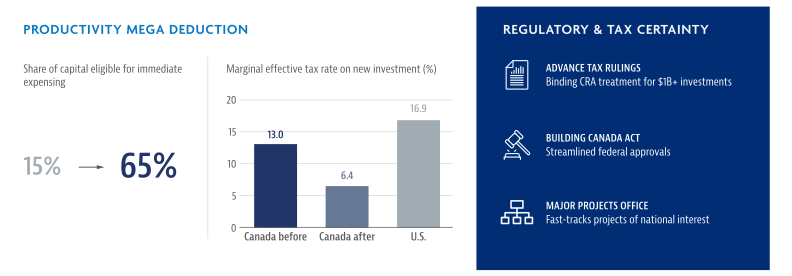
Source: Government of Canada, as of September 15, 2026.
Canada Investment Summit: nearly $500B in commitments
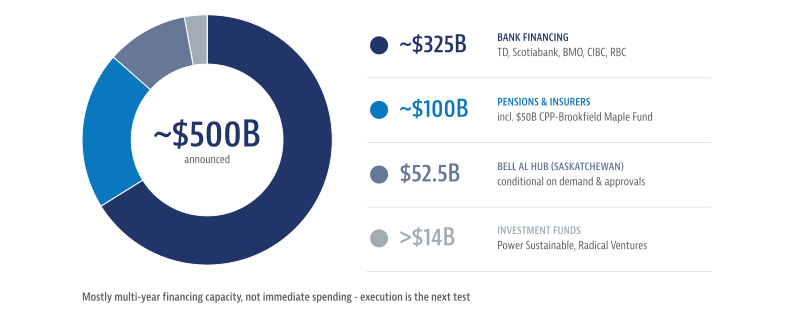
Source: Prime Minister’s Office, as of September 15, 2026.
2. The AI Boom Is Increasingly a Physical Economy Story, and Canada Is Well Positioned
Most investors continue to view artificial intelligence as a technology story. However, the conversation is shifting from who can build the best models to who can provide the energy, infrastructure, and resources required to support AI at scale. As access to abundant, reliable, and affordable power becomes a strategic advantage, countries rich in energy, critical resources, and infrastructure capacity may become some of the most important beneficiaries of the AI ecosystem. In that regard, Canada is exceptionally well positioned.
For years, Canada's resource-heavy market was viewed as a disadvantage relative to the technology-dominated U.S. market. However, the characteristics that once caused investors to discount Canada may increasingly represent a competitive advantage.
Unlike the S&P 500, which has become heavily concentrated in a relatively small group of technology companies, the Canadian market provides meaningful exposure to businesses tied directly to the physical economy, including energy producers, pipelines, utilities, and infrastructure operators. These are precisely the types of businesses positioned to benefit from rising demand for energy, infrastructure, transportation, and capital investment associated with the AI buildout.
Moreover, Canada possesses many of the assets the world appears to need more of:
- Vast oil and natural gas reserves
- Significant critical mineral resources
- World-class agricultural capacity
- Substantial hydroelectric generation
- Strong institutions and governance
- Political stability relative to many competing jurisdictions
As geopolitical tensions rise and countries increasingly prioritize energy security and supply-chain resilience, access to these resources becomes more valuable. The world may be entering an environment where scarcity of physical assets matters more than abundance of digital assets. If that proves true, Canada's market composition could become a significant advantage rather than a limitation.
Real-Economy Sector Weights: Canada vs U.S.
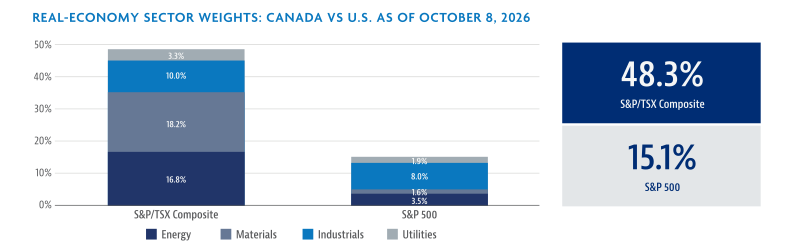
Source: Bloomberg Finance L.P. as of October 8, 2026.
3. This is not a call to abandon the United States, but it might be time to reconsider European exposure
Importantly, this is not an "either-or" argument with respect to Canada vs U.S. The United States remains home to many of the world's most innovative and highest-quality businesses. Much of the global AI ecosystem continues to be led by U.S. companies, and many of the world's strongest secular growth opportunities remain concentrated there. Investors should continue to maintain meaningful exposure to U.S. equities but be more cognizant of the level of concentration particularly within large-cap growth companies. Canada offers something different. It provides exposure to sectors and economic drivers that may become increasingly important in a world characterized by deglobalization, energy security and reindustrialization. Rather than replacing U.S. exposure, Canadian equities can complement it.
Our view is a bit different with respect to European equities. Europe’s worsening fiscal instability presents a powerful structural bull case for Canadian equities, positioning them as a premier safe-haven destination for global capital. With severe disruptions in European bond markets, highlighted by French 10-year yields reaching a 25-year high near 4.9%, the European Central Bank faces a difficult task ahead as they manage fighting inflation while avoiding a severe economic downturn. By contrast, Canadian businesses are benefiting from an increasingly friendly domestic policy and regulatory backdrop, combined with a resource-insulated economy, offering a compelling "flight to stability" play for international investors looking to maintain developed-market exposure while bypassing European sovereign debt panics.
Ultimately, while standard global equity portfolios leave investors heavily overexposed to the fiscal fragility of Europe and the tech-heavy concentration of the US, Canada remains a crucially underrepresented market, making a dedicated Canada-centric allocation a valueable tool for capturing overlooked, high-conviction growth in a fractured global landscape.
Canada Has Outperformed Both the US and EAFE Since Liberation Day
Price Performance Since Liberation Day
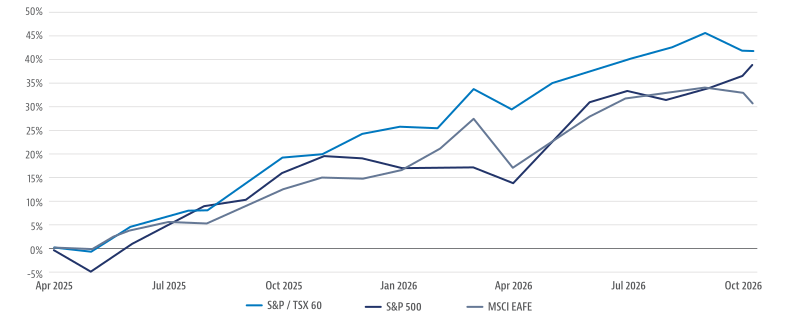
Source: Morningstar Direct Inc. as of October 9, 2026.
Bottom Line
Canada is home to many of the businesses supplying the energy, infrastructure, financing, transportation, and resources needed to support the next phase of global growth, placing the country at the intersection of several powerful long-term trends. The country possesses many of the resources the world increasingly needs, a stock market heavily exposed to the physical economy, and a policy backdrop that appears more supportive of investment and growth than it has been in years.
Investors do not need to abandon the United States to benefit from these opportunities. However, they should consider whether current portfolio allocations adequately reflect Canada's improving long-term outlook. In our view, Canada once again deserves consideration as a core strategic allocation, not simply a home-country bias position, but a differentiated source of long-term return potential in an increasingly resource and infrastructure constrained world.
How to Express the View: Canadian Equity Solutions from CI
For investors looking to reposition portfolios toward Canadian equities, CI Global Asset Management offers a range of solutions, each designed to capture elements of Canada’s market opportunity.
Fund | Fund Code | MER (%) | 1 Mo | 3 Mo | 6 Mo | YTD | 1Yr | 3 Yr | 5Yr | 10Yr |
|---|---|---|---|---|---|---|---|---|---|---|
CIG718 | 1.00 | -1.2 | 2.3 | 11.9 | 24.3 | 27.9 | 27.5 | 14.6 | 13.4 | |
CI AIMvest Select Canadian Equity Fund (formerly Invesco Select Canadian Equity Fund) (Series F) | AIM1587 | 0.85 | 4.3 | 1.0 | 9.6 | 15.3 | 19.2 | 20.3 | 12.6 | 11.7 |
CI AIMvest Pure Canadian Equity Fund (formerly Invesco Pure Canadian Equity Fund) (Series F) | AIM1557 | 0.85 | 3.4 | 2.1 | 6.5 | 12.9 | 15.9 | 22.8 | 13.3 | 11.3 |
CIG7426 | 0.95 | 3.2 | 5.7 | 11.7 | 14.8 | 21.5 | 9.4 | 10.1 | 1.5 | |
CIG54232 | 1.23 | -1.2 | 1.5 | 1.1 | 5.2 | 6.6 | 19.3 | 6.7 | 9.0 |
Source: Morningstar Direct Inc. as of October 31, 2026.
Since Inception Date - CI Select Canadian Equity Fund: 2000-08-08
Since Inception Date - CI AIMvest Select Canadian Equity Fund (formerly Invesco Select Canadian Equity Fund): 2000-02-11
Since Inception Date - CI AIMvest Pure Canadian Equity Fund (formerly Invesco Pure Canadian Equity Fund): 2000-02-11
Since Inception Date - CI Canadian Investment Fund: 2000-11-17
Since Inception Date - CI Canadian All Cap Equity Income Fund: 2009-09-18
About the Author

Dillon Suresh is a Director, Institutional Portfolio Manager at CI Global Asset Management, where he oversees the firm’s equity strategies. In this role, he delivers portfolio insights to institutional and advisor audiences while supporting the positioning and growth of CI GAM’s equity solutions.
Prior to joining CI GAM, Dillon was a Senior Associate on the Investment Strategy Group at BMO. His work involved developing market outlooks and contributing to the development of year end market targets for the S&P 500 and the S&P TSX Composite. He previously worked at Willis Towers Watson as an investment consultant, advising institutional clients on asset allocation and portfolio construction decisions.
Dillon holds a Bachelor of Business Administration from the University of Toronto and is a CFA charter holder.
IMPORTANT DISCLAIMERS
Commissions, trailing commissions, management fees and expenses all may be associated with mutual fund investments. Please read the prospectus before investing. The indicated rates of return are the historical annual compounded total returns net of fees and expenses payable by the fund (except for figures of one year or less, which are simple total returns) including changes in security value and reinvestment of all dividends/distributions and do not take into account sales, redemption, distribution or optional charges or income taxes payable by any securityholder that would have reduced returns. Mutual funds are not guaranteed, their values change frequently, and past performance may not be repeated.
This communication is published by CI Global Asset Management (“CI GAM”). Any commentaries and information contained in this communication are provided as a general source of information and should not be considered personal investment advice. Facts and data provided by CI GAM and other sources are believed to be reliable as at the date of publication.
Certain statements contained in this communication are based in whole or in part on information provided by third parties and CI GAM has taken reasonable steps to ensure their accuracy. Market conditions may change which may impact the information contained in this document.
Information in this communication is not intended to provide legal, accounting, investment or tax advice, and should not be relied upon in that regard. Professional advisors should be consulted prior to acting based on the information contained in this communication.
The author and/or a member of their immediate family may hold specific holdings/securities discussed in this document. Any opinion or information provided are solely those of the author and does not constitute investment advice or an endorsement or recommendation of any entity or security discussed or provided by CI Global Asset Management. This document is for use by Canadian accredited investors only.
© 2026 Morningstar Research Inc. All Rights Reserved. The information contained herein: (1) is proprietary to Morningstar and/or its content providers; (2) may not be copied or distributed; and (3) is not warranted to be accurate, complete, or timely. Neither Morningstar nor its content providers are responsible for any damages or losses arising from any use of this information. Past performance is no guarantee of future results.
Certain statements in this document are forward-looking. Forward- looking statements (“FLS”) are statements that are predictive in nature, depend upon or refer to future events or conditions, or that include words such as “may,” “will,” “should,” “could,” “expect,” “anticipate,” “intend,” “plan,” “believe,” or “estimate,” or other similar expressions. Statements that look forward in time or include anything other than historical information are subject to risks and uncertainties, and actual results, actions or events could differ materially from those set forth in the FLS. FLS are not guarantees of future performance and are by their nature based on numerous assumptions. Although the FLS contained herein are based upon what CI Global Asset Management and the portfolio manager believe to be reasonable assumptions, neither CI Global Asset Management nor the portfolio manager can assure that actual results will be consistent with these FLS. The reader is cautioned to consider the FLS carefully and not to place undue reliance on FLS. Unless required by applicable law, it is not undertaken, and specifically disclaimed that there is any intention or obligation to update or revise FLS, whether as a result of new information, future events or otherwise.
You may not modify, copy, reproduce, publish, upload, post, transmit, distribute, or commercially exploit in any way any content included in this communication. You may download this communication for your activities as a financial advisor provided you keep intact all copyright and other proprietary notices. Unauthorized downloading, re-transmission, storage in any medium, copying, redistribution, or republication for any purpose is strictly prohibited without the written permission of CI GAM.
The CI AIMvest trademark is owned by CI Investments Inc.
Invesco® and all associated trademarks are trademarks of Invesco Holding Company Limited and are used by CI Global Asset Management under licence.
CI Global Asset Management is a registered business name of CI Investments Inc. ©CI Investments Inc. 2026. All rights reserved.
Published November, 17, 2026
